
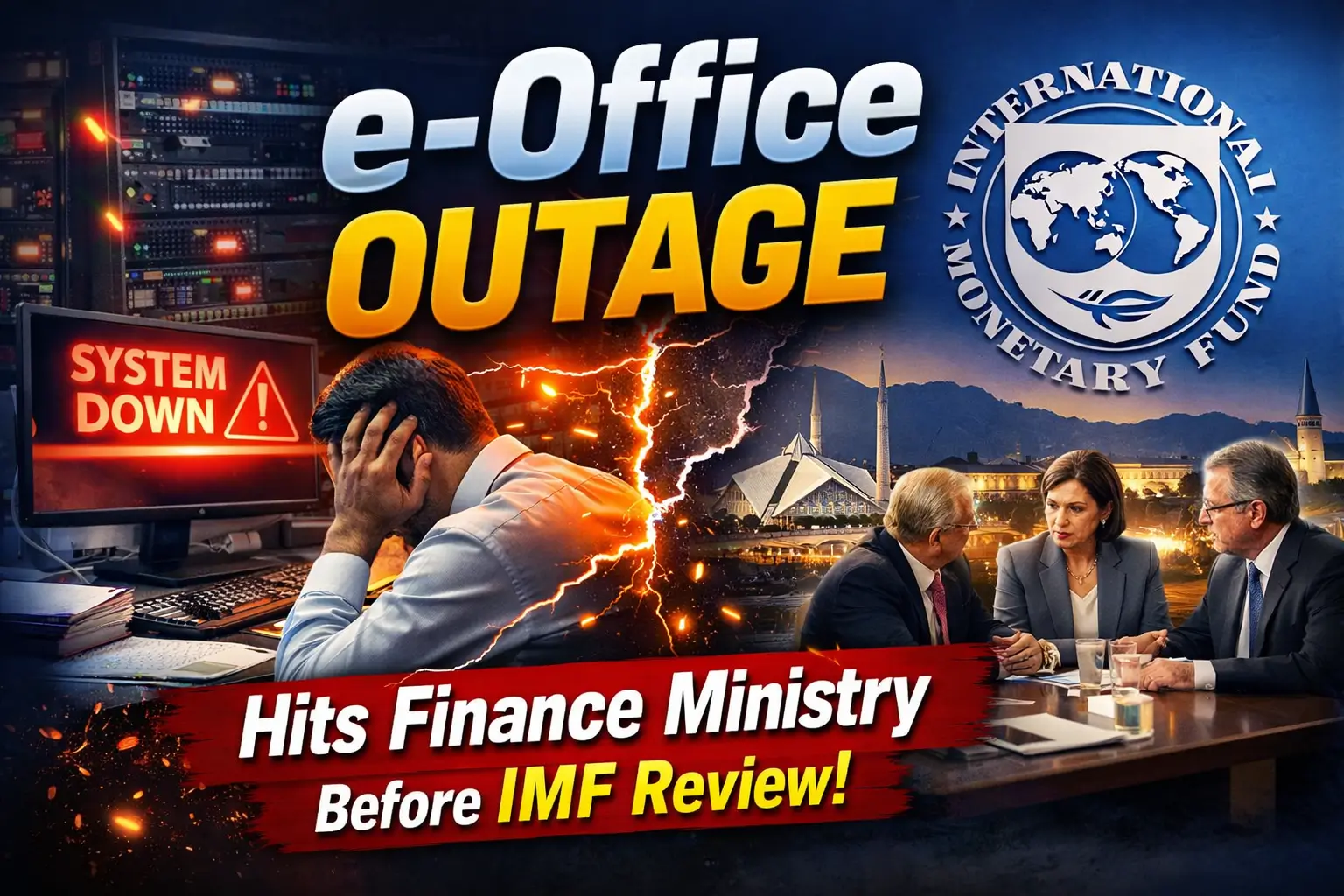
E-Office Outage Before IMF Review 2026 Sparks Concerns. The e-Office outage before IMF Review 2026 has raised serious concerns in Pakistan’s financial circles. Just days before the International Monetary Fund delegation arrived, the Ministry of Finance faced major system disruptions. This unexpected failure slowed official work and triggered questions about digital governance readiness.

When a country prepares for an IMF review, every file, approval, and report matters. A technical breakdown at such a critical moment can affect efficiency, transparency, and international confidence.
What Happened at the Finance Ministry?
Ministry of Finance reported major technical faults in the government’s digital file management platform, commonly known as the e-Office system. Officials formally contacted the National Information Technology Board on February 19 regarding serious workflow disruptions.
The timing was sensitive. A delegation from the International Monetary Fund was preparing to begin its economic review of Pakistan’s financial performance.
Key Issues Reported
- Login authentication failures
- Official files not moving through approval stages
- Slow processing speed
- Frequent system freezes
- Complete halt of digital file movement
These issues reportedly occur every two to three weeks, with no permanent technical solution implemented so far.
Why the IMF Review 2026 Is So Important
An IMF review is not a routine meeting. It is a formal assessment of:
- Fiscal discipline
- Revenue collection targets
- Economic reforms
- Debt sustainability
- Structural policy implementation
Pakistan’s engagement with the IMF affects investor confidence, foreign exchange stability, and financial credibility.

If digital systems fail during such a review, it sends a weak signal about administrative efficiency and governance stability.
Background of the e-Office System
The e-Office platform was introduced under the direction of Shehbaz Sharif to promote paperless governance across federal ministries.
The goal was simple:
Replace manual file movement with a secure digital workflow system.
In theory, it improves transparency, speeds up approvals, and reduces corruption risks. But repeated outages have raised questions about system capacity and infrastructure readiness.
Technical Reasons Behind the Outage
According to NITB officials, the system was under maintenance and optimization due to heavy traffic pressure.

Possible Causes
1. Increased User Load
More departments are being onboarded to the platform. This increases server traffic.
2. Infrastructure Limitations
If servers are not upgraded on time, systems can slow down or crash.
3. Security Upgrades
New security measures sometimes create temporary performance issues.
4. Lack of Stress Testing
Regular stress testing ensures the system can handle peak loads.
e-Office System Issues at a Glance
| Problem Area | Reported Issue | Impact on Work |
|---|---|---|
| Login System | Authentication failures | Staff unable to access files |
| Workflow | Files stuck in approval stages | Delays in decision-making |
| Performance | System extremely slow | Reduced productivity |
| Stability | Frequent freezing | Interrupted operations |
| Recurrence | Glitches every 2–3 weeks | Ongoing operational risk |
This recurring pattern suggests deeper technical and management gaps.
Impact on Pakistan’s Economic Operations
The timing of this outage is critical.

When a Finance Ministry cannot move files efficiently:
- Budget approvals slow down
- Policy documents face delays
- International communication becomes difficult
- Economic coordination suffers
For IMF discussions, data accuracy and timely documentation are essential. Any disruption creates pressure on officials and can weaken negotiation strength.
Digital Governance vs Ground Reality
Pakistan has been promoting digital transformation under its e-governance strategy. The aim includes:
- Paperless ministries
- Secure digital workflows
- Transparency in public finance
- Faster decision-making
However, repeated outages show a gap between policy vision and implementation quality.
A digital system is like a house. If the foundation is weak, adding more rooms will not solve the problem. The base infrastructure must be strong first.
NITB’s Response and Proposed Solutions
NITB acknowledged the disruption and announced:

- Infrastructure upgrades
- Establishment of a disaster recovery site
- Enhanced cybersecurity measures
- Planned stress testing
A disaster recovery site ensures backup operations if the main server fails. This improves system resilience.
Officials stated that services were restored and a weekend stress test would evaluate capacity and stability.
Is This a Temporary Issue or a Structural Problem?
Frequent outages every few weeks suggest this may not be just routine maintenance.
There are three possibilities:
- Capacity Miscalculation – System demand underestimated
- Budget Constraints – Insufficient funding for upgrades
- Technical Architecture Gaps – Poor system scalability
For a federal-level digital system, scalability is critical. It must handle peak traffic without disruption.
FAQs
What caused the e-Office outage before the IMF Review 2026?
The outage was reportedly due to heavy traffic load, system maintenance, and infrastructure limitations, according to NITB officials.

How does the e-Office system work in Pakistan?
The e-Office system digitizes file movement and approvals within federal ministries to promote paperless governance and transparency.
Did the outage affect the IMF delegation meetings?
While services were restored, the disruption occurred just days before the IMF review, raising concerns about operational readiness.
How often does the e-Office system face issues?
Officials indicated that similar glitches have occurred every two to three weeks without a permanent fix.
What steps are being taken to prevent future outages?
NITB announced infrastructure upgrades, security enhancements, disaster recovery setup, and system stress testing.
Conclusion
The e-Office outage before IMF Review 2026 highlights the importance of reliable digital infrastructure in modern governance. While Pakistan aims to strengthen digital transformation, recurring system failures at critical moments raise concerns about capacity and long-term planning.