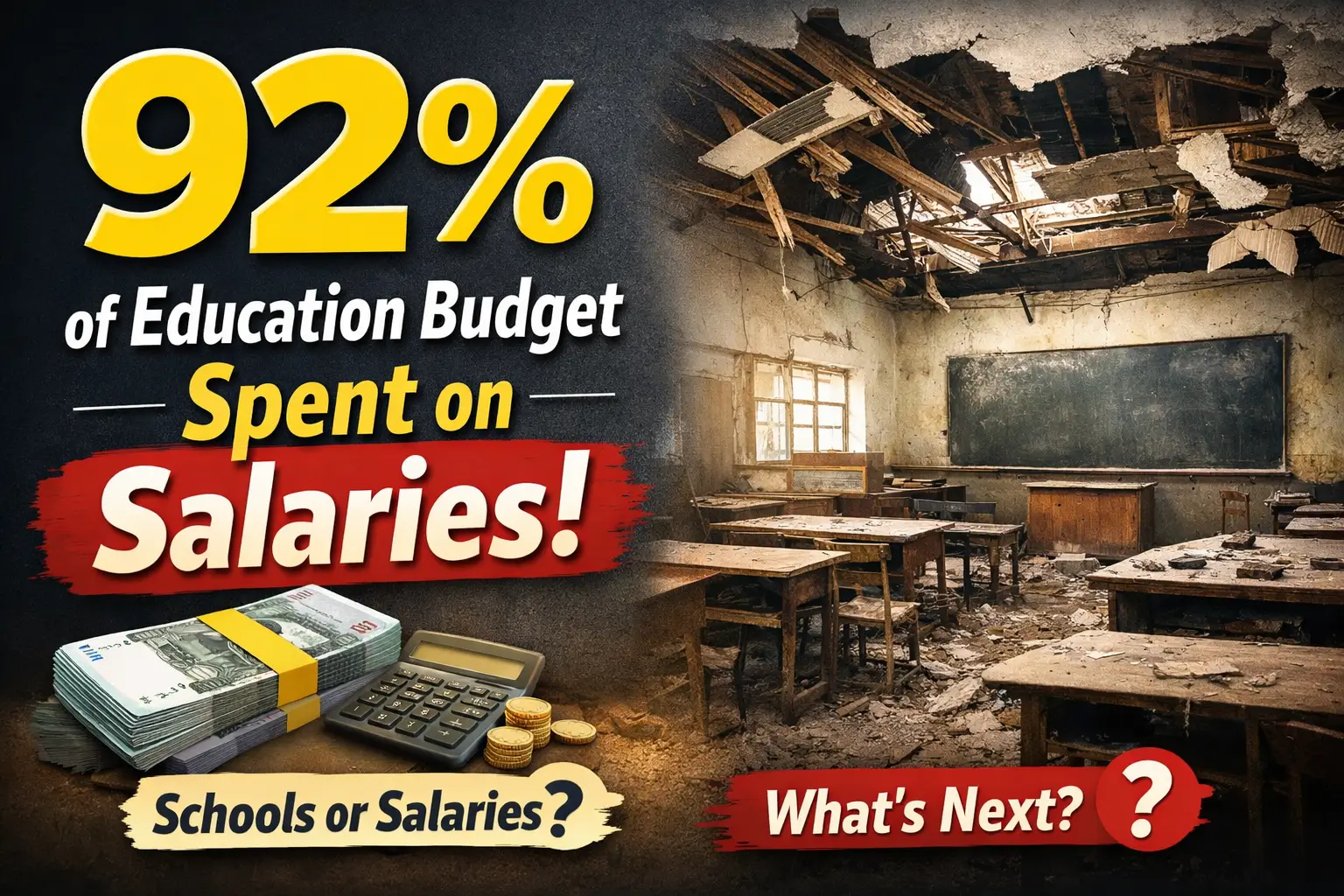
Education Budget 92% on Salaries. Education budget 92% on salaries this statement has raised serious questions about the future of public schools in Sindh. When most funds go to pay and pensions, what remains for classrooms, books, labs, and repairs? In 2026, this debate is more important than ever.

Recently, Sindh Education Minister Syed Sardar Shah shared detailed figures in the Sindh Assembly. His comments revealed deep structural issues in the provincial education system.
Let’s break it down clearly.
Why Is 92% of Education Budget Spent on Salaries?
According to the minister, nearly 92% of the school education budget is used for:
- Salaries of teachers
- Administrative staff payments
- Pension liabilities
This leaves only 8% for:
- Infrastructure upgrades
- Library development
- Science laboratories
- Maintenance and repairs
- Learning materials
What Does This Mean?
Imagine a house where 92% of income is spent only on paying family members, but no money is left for electricity bills, repairs, or groceries. The house will slowly collapse.
The same situation is happening in many government schools.
Teacher Recruitment: Expansion or Burden?
In 2021, the provincial government planned to recruit 50,000 teachers.
However:

- 95,000 teachers have already received offer letters
- 31,000 candidates are still waiting for recruitment
On one side, hiring teachers reduces unemployment. On the other side, it increases salary expenses.
Key Question
Is the education department becoming a job provider rather than a learning-focused institution?
The minister himself warned about this concern.
School Infrastructure Crisis in Karachi
Karachi, the largest city of Sindh, shows alarming data.
Primary Schools
- 1,236 primary schools across 7 districts
- 1,194 have buildings
- Many declared dangerous
Secondary Schools
- 375 secondary schools
- 41 declared unsafe
Overall Unsafe Schools
- 233 primary and secondary schools declared unsafe
- Rs. 4,156 million required for repairs
This is not just a number issue. It is a student safety issue.
Budget Allocation for Schools
The government has allocated:
- More than Rs. 18 billion for schools
- Principals authorized to spend on daily operational needs
This step gives school heads more control. But is the amount enough when 92% already goes to salaries?
Libraries and Science Labs — Missing Essentials
The minister admitted:

- Libraries are scarce
- Science laboratories are limited
- Primary schools are worst affected
Without labs and libraries, how can students develop critical thinking?
Education is not only about teachers. It is about:
- Practical learning
- Research skills
- Experiments
- Reading culture
Girls’ Enrollment at 42% — A Serious Gap
Girls’ enrollment in Sindh stands at 42%.
This means:
- More boys attend school
- Gender gap still exists
- Female literacy progress is slow
For sustainable development, this gap must close.
Private Schools vs Government Schools
Nationwide, around 30 million children attend private schools.
Private school teachers earn:
- Rs. 10,000 to Rs. 12,000 per month
This highlights two issues:

| Factor | Government Schools | Private Schools |
|---|---|---|
| Teacher Salary | High (Budget heavy) | Low |
| Infrastructure | Many unsafe buildings | Generally better |
| Budget Allocation | 92% salaries | Privately managed |
| Student Enrollment | Lower growth | Rapid increase |
Parents often choose private schools due to quality concerns.
Dangerous Schools: Are Students Safe?
Some opposition lawmakers reported:
- Roof collapses
- Unsafe structures
- Urgent repair needs
The minister stated that no teaching is happening in declared dangerous schools. However, reports are three years old.
This raises another concern:
Is monitoring updated regularly?
Hyderabad Teacher Recruitment Controversy
Another issue discussed in the assembly was recruitment in Hyderabad.
Some lawmakers claimed teachers from other cities were hired.
This touches on:

- Local employment rights
- Merit system
- Political influence
Transparent recruitment is essential for trust.
Root Problems Behind Budget Imbalance
Let’s analyze deeper.
1. Pension Pressure
Old pension systems increase financial burden every year.
2. Administrative Expansion
More staff means more recurring costs.
3. Weak Financial Planning
Budget distribution lacks performance-based allocation.
4. Lack of Infrastructure Audit
Unsafe buildings remain for years.
What Needs to Change in 2026?
If reforms are not made, education quality will continue to decline.
Possible Solutions
Budget Rebalancing
Reduce non-essential administrative costs.

Infrastructure Emergency Plan
Repair unsafe schools immediately.
Digital Learning Investment
Introduce smart classrooms and online systems.
Teacher Performance Monitoring
Focus on quality, not just quantity.
Gender Inclusion Strategy
Increase girls’ enrollment beyond 42%.
FAQs
Why is most of Sindh’s education budget spent on salaries?
Because teacher wages and pensions consume the majority of allocated funds.
How many schools in Karachi are unsafe?
Around 233 primary and secondary schools are declared unsafe.
How much money is required for repairs?
Approximately Rs. 4,156 million is needed for infrastructure repair.
What is the girls’ enrollment rate in Sindh?
The current enrollment rate stands at 42%.
Are private school teachers paid more than government teachers?
No. Private school teachers often earn between Rs. 10,000 and Rs. 12,000 monthly.
Conclusion
Education budget 92% on salaries is not just a statistic. It reflects structural imbalance. Schools need safe buildings, libraries, labs, and updated monitoring systems.