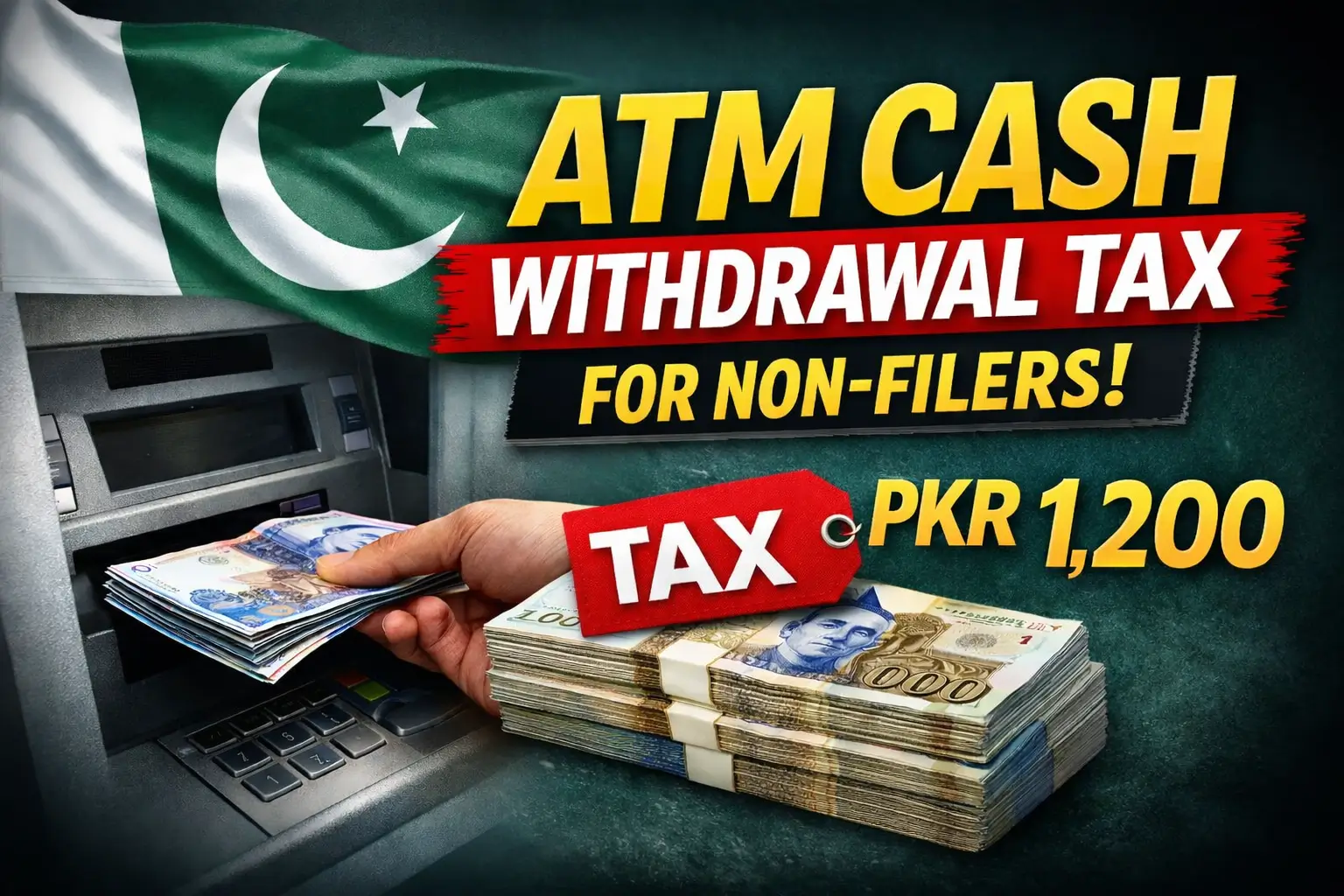
Pakistan Budget ATM Cash Withdrawals Tax For Non-Filers Explained In 2026. Pakistan Budget 2026 has proposed a higher ATM cash withdrawals tax for non-filers, directly impacting bank users across the country. If you withdraw Rs100,000 from your account, you may now pay Rs1,200 in tax. Here is everything you need to know about the new withholding tax, exemption threshold, and how it affects you.

What Is the ATM Cash Withdrawals Tax in Pakistan Budget 2026?
Under Pakistan Budget 2026, the government has proposed increasing the withholding tax on cash withdrawals for individuals who are not registered tax filers with the Federal Board of Revenue (FBR).
Previously, non-filers paid 0.6% tax on large withdrawals. The new proposal doubles that rate to 1.2%, which equals Rs1,200 on every Rs100,000 withdrawn.
This tax is automatically deducted by banks at the time of withdrawal. You do not need to calculate or pay it separately. The bank deducts it instantly and transfers it to the government.
Key Highlights
- Proposed rate for non-filers: 1.2%
- Previous rate: 0.6%
- Possible revision under review: 0.8%
- Deduction method: Automatic by banks
- Regulator: Federal Board of Revenue (FBR)
Why Has the Government Increased the Withholding Tax?
The main goal behind this policy is to expand Pakistan’s tax base and reduce undocumented cash transactions.
According to the Federal Board of Revenue (FBR), a large portion of financial activity happens outside the documented tax system. Many individuals use banking services but do not file income tax returns.
By increasing the ATM cash withdrawals tax for non-filers, the government aims to:
- Encourage tax registration
- Reduce the informal economy
- Improve financial transparency
- Increase national revenue
- Promote digital banking
Pakistan has long struggled with a narrow tax net. Only a small percentage of the population files income tax returns. This new measure puts pressure on non-filers to register.

Understanding the Rs1,200 Tax on Rs100,000 Withdrawal
Let’s simplify this with an example.
If you withdraw Rs100,000 from your bank account:
- Tax rate: 1.2%
- Tax deducted: Rs1,200
- Amount you receive: Rs98,800
This deduction applies only if you are a non-filer. If you are an active tax filer listed on the FBR Active Taxpayers List (ATL), this higher tax does not apply.
Proposed Rs75,000 Exemption Threshold
The government is also considering an exemption limit of Rs75,000.
If approved:
- Withdrawals below Rs75,000 may be tax-free for non-filers.
- Tax would apply only when the amount exceeds the threshold.
This proposal is still under review by the National Assembly finance committee.
Who Will Benefit From the Exemption?
- Daily wage earners
- Small traders
- Low-income individuals
- People making small monthly withdrawals
This move aims to protect lower-income groups from additional financial burden.

Comparison Table: Old vs New Tax Policy
| Feature | Previous Policy | Pakistan Budget 2026 Proposal |
|---|---|---|
| Tax Rate for Non-Filers | 0.6% | 1.2% |
| Tax on Rs100,000 | Rs600 | Rs1,200 |
| Exemption Limit | Not clear | Rs75,000 (under review) |
| Deduction Method | Automatic by bank | Automatic by bank |
| Impact on Filers | Lower rate | Likely exempt |
This table clearly shows how the burden has increased for non-filers.
How This Policy Impacts Non-Filers
Non-filers will feel the direct financial impact.
1. Higher Cash Transaction Cost
Every large withdrawal becomes expensive. Frequent cash users will lose more money in deductions.
2. Banking Restrictions
The government is also considering additional restrictions for non-filers, including:
- Limited investment opportunities
- Restrictions on property purchases
- Difficulty opening new bank accounts
- Limited access to financial instruments
These steps aim to push individuals toward becoming tax filers.
Benefits for Tax Filers
If you are already a tax filer, this policy works in your favor.
Advantages of Being a Filer:
- Lower or zero withholding tax
- Easier property transactions
- Better banking privileges
- Access to investments
- Lower tax rates on vehicles and property
The government wants to reward compliant taxpayers and discourage tax avoidance.

Role of the Federal Board of Revenue (FBR)
The Federal Board of Revenue is responsible for implementing tax laws in Pakistan. The Active Taxpayers List (ATL) is updated regularly to identify registered filers.
If your name appears on the ATL, you are treated as a filer and can avoid higher withholding taxes.
Banks verify your status directly from the FBR database before applying tax deductions.
How to Avoid the ATM Cash Withdrawals Tax
The simplest way to avoid paying 1.2% tax is to become a registered tax filer.
Step-by-Step Process:
Step 1: Register on FBR Iris Portal
Visit the official FBR website and create an account.
Step 2: Obtain NTN
Apply for a National Tax Number (NTN).
Step 3: File Income Tax Return
Submit your annual income tax return.

Step 4: Check Active Taxpayers List
Ensure your name appears on the ATL.
Once registered, the higher ATM cash withdrawals tax for non-filers will no longer apply to you.
Impact on Small Businesses and Traders
Small traders often operate in cash. This policy may increase their operating costs.
However, the long-term goal is to shift businesses toward:
- Digital payments
- Bank transactions
- Proper documentation
- Tax compliance
Over time, this could modernize Pakistan’s financial ecosystem.
Is This Proposal Final?
The Pakistan Budget 2026 proposal is under parliamentary review. There are discussions about revising the rate to 0.8% instead of 1.2%.
Final approval will depend on:

- Finance committee recommendations
- National Assembly debate
- Economic impact assessment
Citizens should monitor official announcements from the Ministry of Finance and FBR.
Economic Impact of the Policy
The government expects to generate billions of rupees in additional revenue through this withholding tax.
Broader Economic Goals:
- Strengthen tax collection
- Reduce fiscal deficit
- Increase IMF confidence
- Improve documentation of economy
- Promote digital banking
This move aligns with Pakistan’s economic reform agenda.
FAQs About Pakistan Budget 2026 ATM Cash Withdrawals Tax
1. What is the new ATM withdrawal tax for non-filers in Pakistan Budget 2026?
The proposed tax rate is 1.2% on large cash withdrawals. This equals Rs1,200 on Rs100,000.
2. Does this tax apply to tax filers?
No. Registered tax filers listed on the FBR Active Taxpayers List are either exempt or subject to lower rates.
3. Is there any exemption limit?
The government is reviewing a Rs75,000 exemption threshold. Withdrawals below this may remain tax-free.
4. How can I check if I am a filer?
You can check your status on the Federal Board of Revenue website by searching the Active Taxpayers List.
5. When will the new tax take effect?
It will apply after final approval of Pakistan Budget 2026 by Parliament.
Conclusion
Pakistan Budget 2026 has introduced a major change by increasing the ATM cash withdrawals tax for non-filers to 1.2%. This policy aims to expand the tax net, improve financial transparency, and push citizens toward tax compliance. While non-filers may face higher deductions, tax filers will benefit from lower rates and fewer restrictions.