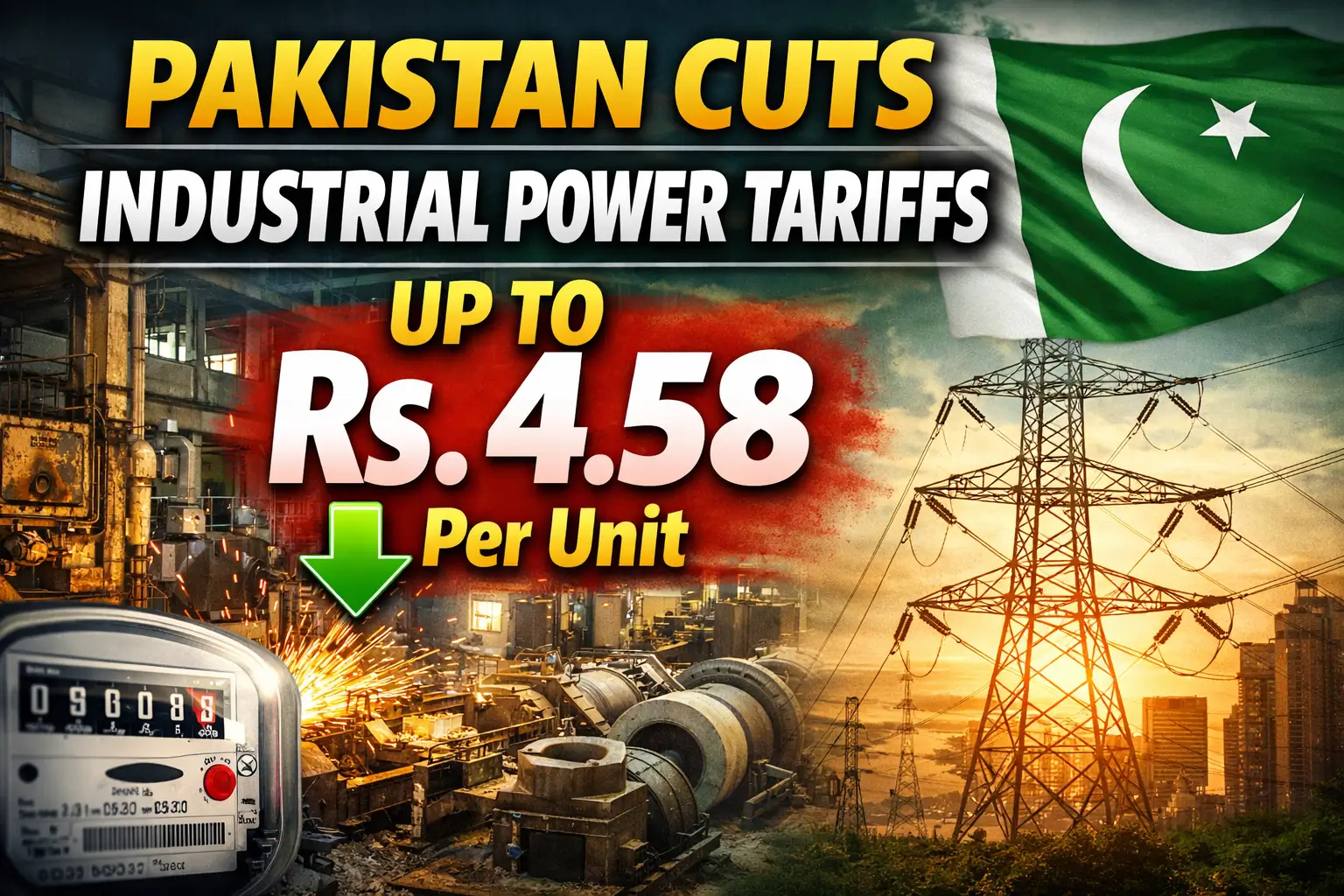
Pakistan Cuts Industrial Power Tariffs 2026: What It Means for Businesses. Pakistan cuts industrial power tariffs 2026, giving factories long-awaited relief from high electricity costs. The government has reduced rates by up to Rs. 4.58 per unit. This move may support exports, boost production, and ease pressure on manufacturers.

If you run a factory, manage energy costs, or track economic policy, this update matters. Here is the complete breakdown of new tariffs, categories, and what it means for businesses and households.
Government Officially Notifies Tariff Reduction
The federal government has issued a formal notification after approval from National Electric Power Regulatory Authority.
The decision follows NEPRA’s ruling dated February 11, 2026. The new rates are effective from February 2026 and will remain applicable until December 2026.
The revision applies to:
- All government distribution companies (DISCOs)
- K-Electric
- Industrial and selected domestic consumer categories
This step replaces earlier tariff notifications issued in January 2026.

Why Pakistan Reduced Industrial Power Tariffs in 2026
Pakistan has faced some of the highest electricity costs in the region. High power prices reduce competitiveness, especially for:
- Textile exporters
- Steel manufacturers
- Cement factories
- Small industrial units
Energy is a major cost in production. When electricity prices drop, businesses can:
- Lower production cost
- Increase output
- Compete in export markets
- Retain workforce
The 2026 industrial power tariff cut aims to improve economic activity and support industrial growth.
New Industrial Tariff Structure 2026
Below is a simplified breakdown of updated rates across industrial categories.
B1 Category – Small Industrial Consumers (Up to 25 kW)
This category includes small workshops and light industrial units on low-tension supply.


Revised Energy Charges
| Component | Previous Rate | New Rate |
|---|---|---|
| Energy Charge | Rs. 30.80 | Rs. 26.23 |
| Peak Rate | Rs. 36.74 | Rs. 35.74 |
| Off-Peak Rate | Rs. 30.05 | Rs. 25.48 |
Key Change
- New fixed monthly charge introduced: Rs. 1,250 per consumer
This is the first time B1 consumers will pay a fixed charge.
B2 Category – Medium Industries (25–500 kW)
This includes medium-sized manufacturing plants.
Revised Energy Charges
| Component | Previous Rate | New Rate |
|---|---|---|
| Energy Charge | Rs. 30.73 | Rs. 26.16 |
| Peak Rate | Rs. 36.68 | Rs. 35.68 |
| Off-Peak Rate | Rs. 27.41 | Rs. 22.83 |
Fixed Charge
- Remains unchanged at Rs. 1,250 per kW per month.
The largest benefit comes from reduced off-peak rates.
B3 Category – High-Tension (11–33 kV)
Large industrial units connected at high voltage fall into this category.
Revised Energy Charges
| Component | Previous Rate | New Rate |
|---|---|---|
| Energy Charge | Rs. 31.00 | Rs. 27.00 |
| Peak Rate | Rs. 36.68 | Rs. 35.68 |
| Off-Peak Rate | Rs. 28.24 | Rs. 23.67 |
Fixed Charge
- Rs. 1,250 per kW per month (no change)
B4 Category – Large Industrial Users (66–132 kV and Above)
These are the biggest energy consumers in Pakistan.

Revised Energy Charges
| Component | Previous Rate | New Rate |
|---|---|---|
| Energy Charge | Rs. 30.43 | Rs. 26.43 |
| Peak Rate | Rs. 36.68 | Rs. 35.68 |
| Off-Peak Rate | Rs. 27.96 | Rs. 23.38 |
Fixed Charge
- Rs. 1,250 per kW per month (unchanged)
How Much Relief Are Industries Getting?
Across categories, energy charges are reduced by approximately Rs. 4 to Rs. 5 per unit.
The biggest relief comes from:
- Lower off-peak tariffs
- Stable fixed charges
- Reduced per-unit cost
Export-based industries that run machines at night will benefit more.
Impact on Domestic Consumers
While the focus is on industrial tariffs, domestic users also see adjustments.
Lifeline Consumers
- Up to 50 units: Rs. 3.95 per unit
- 51–100 units: Rs. 7.74 per unit
- No fixed charges
These rates remain unchanged.

Protected Domestic Consumers
| Consumption | Fixed Charge |
|---|---|
| 1–100 units | Rs. 200 per kW |
| 101–200 units | Rs. 300 per kW |
Non-Protected Consumers
Fixed charges range from Rs. 275 to Rs. 675 per kW per month.
Per Unit Reductions
- 301–400 units: Reduced to Rs. 36.46
- 401–500 units: Reduced to Rs. 38.95
- 501–600 units: Reduced to Rs. 40.22
- Above 700 units: Reduced to Rs. 47.20
Lower usage slabs see minimal changes.
Economic Impact of Pakistan’s Power Tariff Cut 2026
The tariff reduction may:
- Support industrial recovery
- Improve export competitiveness
- Attract investment
- Stabilize production costs
Energy pricing plays a key role in Pakistan’s GDP performance. Industrial growth often reflects directly in economic indicators.
Key related entities include:

- Ministry of Energy Pakistan
- Power Division
- Distribution Companies (DISCOs)
Lower tariffs can help reduce inflation pressure from the production side.
Comparison: Before vs After 2026 Tariff Revision
| Category | Avg Reduction | Fixed Charge Change |
|---|---|---|
| B1 | ~Rs. 4.5 | New fixed charge added |
| B2 | ~Rs. 4.5 | No change |
| B3 | ~Rs. 4 | No change |
| B4 | ~Rs. 4 | No change |
This shows a uniform approach across industrial segments.
FAQs About Pakistan Industrial Power Tariffs
1. When did Pakistan cut industrial power tariffs in 2026?
The revised tariffs became effective in February 2026 after NEPRA approval.
2. How much reduction per unit is given?
Industries receive up to Rs. 4.58 per unit reduction depending on category.
3. Does the new tariff apply to K-Electric consumers?
Yes. The revised framework applies to K-Electric and all DISCOs.
4. Are domestic electricity rates also reduced?
Some domestic slabs see small reductions. Lifeline consumers remain unchanged.
5. Will the reduced tariff remain permanent?
The notification states validity until December 2026.
Conclusion
Pakistan cuts industrial power tariffs 2026 in a move aimed at supporting industries and economic recovery. With reductions up to Rs. 4.58 per unit, manufacturers gain cost relief. Export sectors may benefit most due to lower off-peak rates.