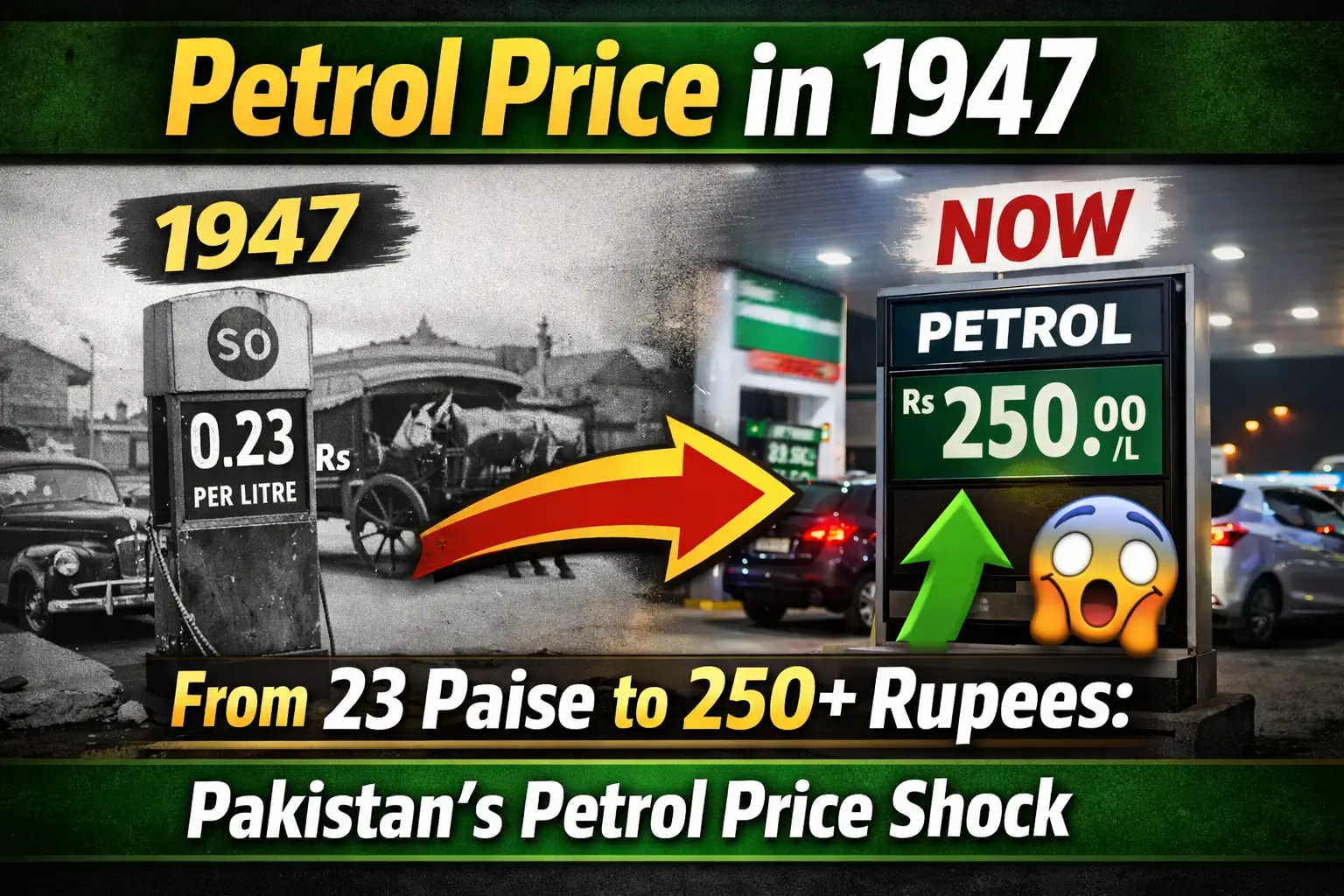
Petrol Price in 1947 To 2026. Petrol Price in 1947 Pakistan was only 23 to 32 paise per litre. Today, it stands above 250 rupees. This massive jump shocks many people. How did fuel become 1,000 times more expensive in 78 years? Let’s break down the full story with facts, data, and economic reasons.

Petrol Price in 1947 Pakistan: The Starting Point
In August 1947, Pakistan became independent. The country had:
- Very few cars
- Limited petrol pumps
- Mostly bicycles and tongas on roads
- Low industrial activity
The petrol price in 1947 ranged between Rs. 0.23 to Rs. 0.32 per litre.
If someone filled a 40-litre tank in 1947, it would cost around Rs. 10–13 only. Today, that same tank costs more than Rs. 10,000.
Why Was Petrol So Cheap in 1947?
Several reasons explain the low fuel price:
- Global oil prices were low after World War II
- Demand for petrol in Pakistan was extremely small
- The government kept prices controlled
- Taxes on petroleum were minimal
- The population was only around 33 million
Petrol was not a daily necessity for most families. It was mainly used by government vehicles, elite families, and transport services.
Petrol Price Timeline: 1947 to 2026
Below is a simplified petrol price history in Pakistan:
| Year/Decade | Approx Petrol Price | Major Reason |
|---|---|---|
| 1947 | Rs. 0.23–0.32 | Low demand, post-war oil stability |
| 1960s | Rs. 0.40–0.60 | Slow industrial growth |
| 1973 | Rs. 0.48–1.20 | Global Oil Crisis |
| 1980s | Rs. 2.50–3.00 | Import dependence rising |
| 1990s | Rs. 6–11 | Economic reforms & demand growth |
| 2000s | Rs. 30–60 | Global oil boom |
| 2010s | Rs. 73–110 | IMF programs, taxes |
| 2023 | Rs. 331 (peak) | Rupee crash + global crisis |
| 2026 | 250+ rupees | Import cost + taxes + inflation |
From 23 paise to over 250 rupees. That is more than 1,000x increase.
Major Events That Changed Pakistan’s Petrol Prices
1. 1973 Oil Crisis
The first big shock came during the global oil embargo. Oil-producing countries reduced supply. Prices jumped worldwide. Pakistan also suffered.
This event changed the fuel pricing structure permanently.

2. Rupee Devaluation
Pakistan imports most of its crude oil. Payments are made in US dollars.
When the Pakistani rupee weakens against the dollar, petrol becomes expensive instantly.
For example:
- If oil costs $100
- Dollar rate increases
- Pakistan pays more in rupees
This directly increases petrol prices.
3. Government Taxes and Petroleum Levy
Petrol price includes:
- Base oil cost
- Refinery margin
- Dealer commission
- Petroleum levy
- Sales tax
A large part of today’s petrol price comes from government taxes. These taxes help fund national budgets.
4. IMF Programs
Under agreements with the International Monetary Fund, Pakistan often reduces fuel subsidies.
Subsidy removal leads to immediate price hikes.
5. Population and Vehicle Explosion
In 1947:

- Population: ~33 million
- Very few cars
In 2026:
- Population: 240+ million
- Millions of motorcycles, cars, buses
More demand = higher imports = more pressure on prices.
Comparison: 1947 vs 2026 Petrol Reality
Let’s compare two eras clearly.
1947 Pakistan
- Few vehicles
- Minimal traffic
- No major highways
- Fuel luxury item
2026 Pakistan
- Motorway networks
- Urban traffic congestion
- Ride-hailing services
- Delivery economy
- Generator use during power cuts
Petrol today powers transport, logistics, agriculture, and industries.
How Much Did Petrol Increase in Percentage?
From Rs. 0.23 to Rs. 250:
That is an increase of over 108,000% approximately.
Even adjusted for inflation, petrol rose more than normal price growth.
Is Petrol Really 1,000 Times Expensive?
Yes, numerically.
0.23 → 250+

But we must understand:
- Currency value changed
- Income levels increased
- Economic size expanded
In 1947, average monthly salary was very low. Today salaries are higher, but fuel still feels expensive because transport is essential.
Why Petrol Price in Pakistan Is So Sensitive?
Pakistan does not produce enough oil domestically. It depends heavily on imports.
Main imported crude suppliers include:
- Saudi Arabia
- United Arab Emirates
- Other global exporters
Any global crisis impacts prices quickly.
Examples:
- Gulf Wars
- 2008 oil boom
- COVID-19 disruption
- Russia-Ukraine war
Global oil volatility always affects Pakistan.
Role of the State Bank and Dollar Rate
The State Bank of Pakistan controls monetary policy.
If foreign reserves are low, the rupee weakens.
Weak rupee = expensive imports = higher petrol prices.
This cycle repeats during economic instability.
What Makes Up Today’s Petrol Price?
Here is a simplified breakdown:
- International oil price
- Freight charges
- Insurance
- Refinery processing cost
- Distribution margin
- Petroleum levy
- Sales tax
Government policies directly impact the final retail price.
Psychological Shock: Why People Feel It More Today
In 1947, petrol was optional.
Today, it affects:
- School transport
- Office commute
- Food delivery
- Online business
- Electricity backup
Every sector depends on fuel. That is why price increases create public reaction.
Could Petrol Ever Become Cheap Again?
Realistically, returning to extremely low prices is unlikely because:
- Pakistan still imports oil
- Global energy demand is high
- Climate policies are changing energy markets
- Currency volatility continues
However, electric vehicles and renewable energy may reduce long-term pressure.

Petrol Price and Pakistan’s Economy: Direct Impact
High petrol prices increase:
- Transportation cost
- Food prices
- Inflation rate
- Production expenses
This creates a chain reaction in the economy.
Economists call this cost-push inflation.
FAQs About Petrol Price in 1947 Pakistan
What was the petrol price in 1947 in Pakistan?
Petrol cost between Rs. 0.23 and Rs. 0.32 per litre at independence.
Why was petrol so cheap in 1947?
Low demand, low taxes, limited vehicles, and stable global oil prices kept it affordable.
What is the current petrol price in Pakistan 2026?
It is above 250 rupees per litre, depending on government revisions.
When did petrol cross 100 rupees in Pakistan?
It crossed 100 rupees during the late 2010s due to global oil prices and rupee devaluation.
What caused the biggest petrol price increase?
Major causes include the 1973 oil crisis, IMF agreements, rupee devaluation, and global supply shocks.
Conclusion
Petrol Price in 1947 Pakistan started at just 23 paise. Today, it exceeds 250 rupees. This 78-year journey reflects economic growth, global crises, currency shifts, and policy changes.
Fuel prices are not just numbers. They tell the story of Pakistan’s economic evolution.